
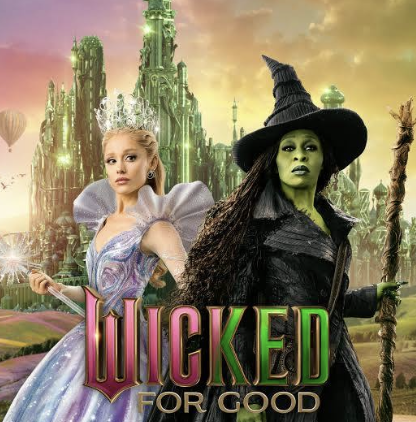
Wicked: For Good is a well-intentioned movie with a good spirit and lively storyline that was simply put in clumsy hands. Of course, watching the movie, I worried to myself that maybe this movie made for children and people who participated in community theatre was not meant to be taken so seriously; then, I thought about the world outside of Gateway Theaters and realized yeah, it definitely is that serious.
Here are my credentials in critiquing this movie: I loved Wicked part one (four stars on Letterboxd by the way) and have seen Wicked live on stage twice. In middle school, it was my favorite musical (and trust me I was deep into theatre), and in high school, I quoted it in my end-of-year theatre president speech. I think that Ariana Grande’s eternal sunshine album is a masterpiece (sue me) and defended Cynthia Erivo through her Jesus Christ Superstar backlash. I thought Wicked: For Good was a shoe-in to be a new favorite of mine. And then, I watched the movie.
Beyond even the awkward pacing and weird editing, I found myself the most disappointed in the handling of the Oz government system and its leaders. (Yes, I read that sentence aloud to myself after I wrote it.)
When handling concepts like oppressive governments and the people within that system whose thumb is pressed down on the society being exploited, intention is key. In making a movie about a bigoted dictator, you never once want to make that dictator seem lovable or incapable of critical thought. It would seem spineless and irresponsible, because the harm that these figures cause overrides if they have lovely children or are married or whatever.
That, to me, is where Wicked: For Good failed. To start with the Wizard, he was made to be a bumbling fool due to his lack of real magic powers, and therefore has only so much control over Oz. He’s a drunk who just wants to have fun, who genuinely longs for a family as more than just a manipulation tactic, and is really just Jeff Goldblum, so what could be so wrong about him? To me, his character is oversimplified to a fault. While he is a silly character, the stage adaptation frames him as more pathetic than sympathetic. He has no business running Oz, yes, but in the same terrible, scary way that most of the politicians currently in office have no business being there, either.
And while whether Glinda ‘the Good’ is deserving of that title could be debated for lifetimes, she is also a significant oppressive force in the government system that is stripping away power and livelihoods of anyone deemed different in Oz. Even if she learns her lesson at the end—after it is too late for Elphaba—she was complicit to the evil deeds of Oz, willing to stay silent and even support (i.e. “Wonderful”) people who she’s witnessed systematically abuse Animals. As Fiyero says, she just “can’t help herself”. The Wicked movie is all too understanding of Glinda’s character, even down to the fact that she performatively places the last few bricks on the Yellow Brick Road, despite the audience seeing moments earlier that the whole thing was built on the labor of Animals.
But, the true evil comes from Madame Morrible, who despite being in the original musical merely an assistant to the Wizard, is now who all the decision making rests on. She is wicked without explanation or cause, unlike the Wizard or Glinda who are oppressors due to their backstories or buried desires. Morrible lacks any of the character building her counterparts get, most significantly to me, her white counterparts.
My true criticism comes in the movie’s failure to treat Jeff Goldblum or Ariana Grande as anything but themselves. While complicit, they do not do any real harm, not when it is really Madame Morrible calling the shots. Their whiteness and visible privilege shields them from criticism about the true powers at play in the real world, because that’s simply too big and bad for lovable, marketable actors like these. In the arms of Hollywood’s white feminism, Wicked: For Good is coddled and cradled and promoted as if it is some big statement against authority, even though what is prioritized is the fact that no one would want to buy a Glinda-branded Dove deodorant if she is portrayed as an antagonist.
Then, that makes Madame Morrible the perfect true villain. Compared to her white counterparts, she is less marketable, and therefore, her story is disposable. Like Nessarose, her storyline is not given any real depth, even though Glinda’s and the Wizard’s are beaten to exhaustion (see the unnecessary “Girl in a Bubble”). Both Morrible and Nessarose are simply evil for material reasons, nothing deep in the psyche, because mainstream audiences do not have to struggle to understand how a person of color could be evil, but white people must always be given a deeper reason. And while I will budge that Nessarose stated that her obsession with Boq and loneliness drove her character, she was not awarded any extra significant scenes or lines to further that thesis, unlike Glinda and the Wizard.
So much of the storyline is focused on Glinda for the sake of Ariana Grande audiences, that the fight for liberation is often overshadowed by one more number, or a flashback scene to make movie viewers coo. It is not as if she does not realize what she is doing or the power she holds—and the power that the Wizard or Madame Morrible hold, for that matter—but to deconstruct the very system that gives her a pretty bubble and all that power is so much work. So, she uses the bird servants to help her get dressed on the night of her wedding, and while she says please and thank you, is unperturbed by the fact that they can not talk back. She allows Ozians to be lied to and stands useless instead of clearing her best friend’s name, even though doing so with her infinite authority would help the Animals more than it would harm herself.
In a world where authoritarianism seeps into the walls of the White House and freedom only rings true to the select minority, making movies like Wicked and Wicked: For Good is so important. That movie does not distance itself from that fact, which makes the lack of criticisms of the white villains within the movie more baffling to me. What the movie does distance itself from is the act of accountability and willingness to allow the concept of bigotry to sit comfortably despite the stakes at hand. While I am not against the idea of people changing and views morphing to ones in favor of liberation, the exemption of the select few for the sake of capitalistic greed or lacking the ability to create a nuanced understanding of bigotry is not a choice that I consider respectable.
Leave a Reply