
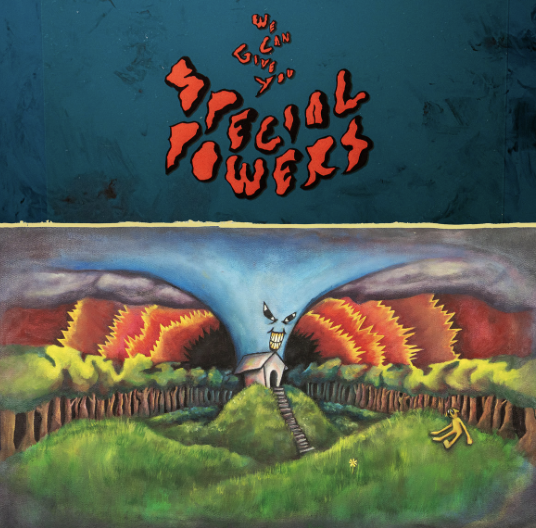
People in the Daytime’s We Can Give You Special Powers has the kind of mysterious allure that only an album (kind of) about a cult can hold. Released on Halloween 2025, the sophomore record from Cleveland-based group, People in The Daytime, is rapidly on its way to becoming a cult classic.
People in the Daytime are made up of guitarist/vocalist Evan Schonauer, synth player/vocalist John Polace, bassist Anthony Liotta, and drummer Owen Barba. Hailing from Northeastern Ohio, this band’s sound exists in the nebulously creative branch of alternative music that lies between pop and rock, between psychedelic, art, crust, and experimental—but is most easily grouped in with hypnagogic pop. I was drawn into the band’s second and most recent album, We Can Give You Special Powers by its refreshingly unique sound and raw, visceral, feel and was lucky to have the chance to speak with the band about the making of the album in late 2025.
According to Polace, the initial inspiration for both the album’s title and concept, as well as the band’s name, was a memorable YouTube misquote. However, as the band progressed into the writing and recording process, the album’s narrative began to form around the power dynamic between beings at the end of their relationship who, although remain nameless on the album, he revealed to be called “The One with The Power” and “The Lamb.”
Within We Can Give You Special Powers, People in the Daytime intentionally set out to convey a different and deeper range of emotions than those of their debut. The weird, mystical feeling that permeates throughout the album is both a reflection of unconventional recording methods and wide-ranging inspirations that went into the creation of We Can Give You Special Powers.
According to Schonauer, when recording, the band chose cassette tapes for their new medium despite the difficulties that accompany the antiquated process, because they were excited to “explore a sound that was really harsh and more aggressive, kind of like throwing caution to the wind.”
The out-dated nature of their medium forced experimentation, trials, and tribulations, as although the band were set on cassette recording, they were not so keen on mixing with tape. Schonauer recounted how the band would arduously “track the cassette tape, play it into an audio interface, into our computer, and we would do that many times for every track we recorded. So then every
track would have ‘essence of tape,’ but we’d actually mix it and everything on the computer,” further recounting how tape added countless hours of painstaking detail work to the album’s recording process.
Nevertheless, the group openly accepted not only the warm and fuzzy sounds, but the blown-out and distorted ones; as a result, the sound on We Can Give You Special Powers is more textured and sonically full, aligning the tone of the music to the album’s emotional plunge.
Polace also recounted how the band experimented in other studio techniques, originally planning on running a Moog synthesizer through every amp in the studio and recording the resulting sound, although they eventually decided to use just two amps. Likewise, Barba scaled back the microphones used to record his drumkit in the pursuit of a vintage drum sound, only using two microphones for several songs where he used up to ten on People in the Daytime’s debut.
The band also used some classic instruments, with Polace specifically mentioning using Wurlitzer, Nord (which also contained a Wurlitzer sound), Sequential Prophet, and Moog keyboards both on the album and on stage. In addition, Schonauer, Polace, and Barba collaborated to engineer the perfect hybrid drum sound by electronically loading samples from the fragile vintage Yamaha DD5 toy drum machine onto a professional-quality sampler.
Throughout this process, the bandmates took inspiration from a group of eclectic yet select discographies. The band considered an eclectic patchwork of influences, from the soul of Marvin Gaye and Sly and the Family Stone to the psych-wizardry of Connan Mockasin, Todd Rundgren, Beach Boys, and Dave Friddman. However, the north star for this record was Magdalena Bay’s Imaginal Disk, which Polace cited as being especially consequential to the shaping of We Can Give You Special Powers: “Imaginal Disk was super important because listening to that album helped me solidify what I want the actual story of the album to be, which is still mysterious to everyone except us.”
In what Liotta calls an album of ‘highs and lows,’ the contrasts that lie between and within songs emulate the rollercoaster of emotions that accompanies a dying relationship. For instance, there are a few repeated elements within the album that create a balancing and unifying factor. Further, parts of the title track’s melody and lyrics are reprised softly in the second halves of each song.
We Can Give You Special Powers’ unexpected and ideally weird songwriting has earned the album’s place in my heart as one of my favorite releases of 2025. While People in the Daytime made an effort on this album to record as closely as possible to how they perform live, you cannot truly experience this band or the album they’re supporting without seeing them for yourself.
You can see People in the Daytime performing live at Ace of Cups in Columbus on Friday, January 30th with opening act Radderall.
Leave a Reply