
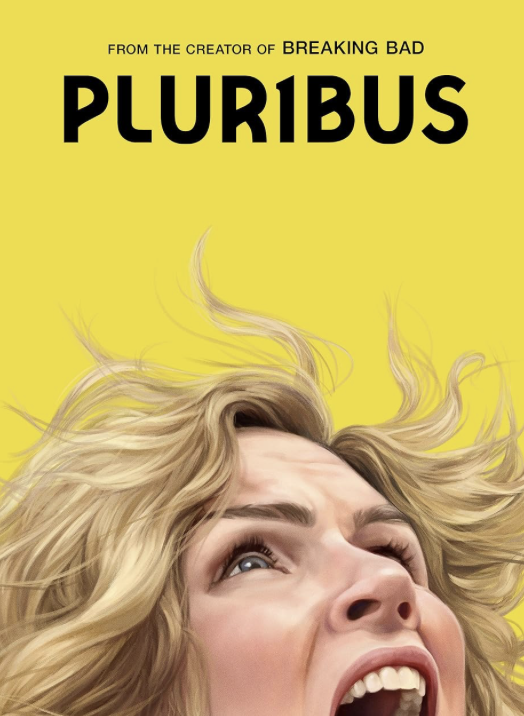
E pluribus unum, or “Out of many, one,” is a Latin motto referenced by the Great Seal of the United States. This phrase alludes to the idea of many individuals uniting together into a single collective nation, a principle central to the founders’ ideals. Yet the unity promised remains arguably unattainable, especially when viewed against the persistent divisions in this country. What, then, would it look like to take this idea to the most literal extreme?
This question is explored in Vince Gilligan’s latest series, Pluribus. After creating some of the most widely respected shows of the twenty-first century, including titles like Breaking Bad and Better Call Saul, Gilligan has decided to go in a whole new direction. While the series draws on familiar science-fiction imagery—particularly the concept of an alien force reshaping the world—Pluribus resists the genre’s usual cliche of invasion or destruction. Instead, it poses a far more complicated proposition: what if everyone became part of a single hivemind set on making the world better? What if there were, practically speaking, no threat at all?
The series follows Carol Sturka, played by Better Call Saul’s Rhea Seehorn, a successful, yet unfulfilled, novelist from Albuquerque, New Mexico. The story unfolds largely from her point of view as a mysterious virus spreads across the globe, rendering people briefly unresponsive. It is soon revealed that the virus has involuntarily transformed humanity into a single, unified hivemind, leaving Carol, among a few others, unaffected for an unexplainable reason. Despite the unconditionally compulsive helpful behavior of the hivemind, Carol immediately views them as a threat, made worse by the fact that her wife did not survive the infection. From here, Carol embarks on a journey of self-imposed isolation that leads her down a path of crippling loneliness.
I was immediately fascinated by the idea that the hive mind is composed of people who want nothing more than to see Carol happy. They’re so eerily peaceful that they won’t even pick an apple from a tree. It’s a compelling concept because it removes the immediate threat we typically expect from the science fiction genre. Instead, the tension centers entirely on Carol as she struggles to navigate and understand this new reality—one with no obvious way to undo it.
The situation grows even more complicated when we encounter others who haven’t been infected—people from vastly different parts of the world who mostly seem wholly uninterested in “saving” humanity. Some even exploit the virus to their benefit, since the hivemind can’t say no to anything asked of them. Watching it all unfold was genuinely infuriating, and I mean that in the best possible way. Carol’s response kept pushing me to reexamine my own views on individuality, to the point where I caught myself thinking, wait… am I the problem?
Another thing that sets Pluribus apart is its frustratingly slow pace, but this works brilliantly with what Gilligan was trying to convey. Towards the middle of the season, we’re as drained as Carol is, completely worn down by everything she’s endured. At this point, she has spent months in total isolation with no real purpose. Understandably, she finally reaches her breaking point, and she has to decide if it’s worth it to be with anyone, even if there is no real connection.
Growing up in America often teaches us to prize individuality above all else. Like Carol, we would likely fight to preserve our sense of self, no matter how painful that struggle becomes. Whether that impulse is noble or selfish is for us to determine. Is rebuilding the world truly a good thing if it isn’t consensual? And if free will is eradicated, do we lose something essential to
our humanity? Gilligan is wise enough not to answer these questions for us.
As we wait for season two, uncertainty lingers. In the closing moments, we’re introduced to a new figure—someone resolute in his mission to stop the hivemind once and for all, even if his approach raises a few uneasy questions.
One thing is undeniable: Carol has a choice to make—something nearly everyone else has lost. That alone makes the stakes feel enormous. I have no idea what a solution to a problem like this could look like, which is exactly why I’m so invested. The suspense is gripping, and I’m genuinely excited to see where it all leads.
Leave a Reply