
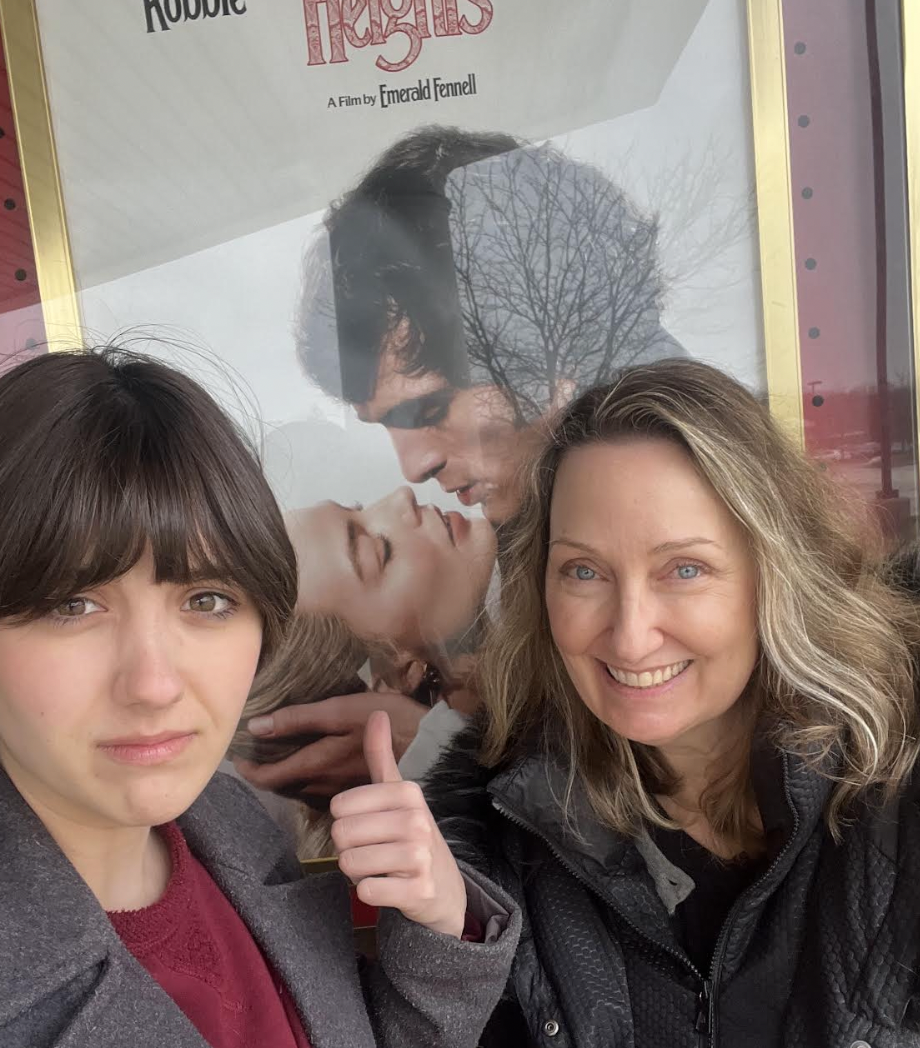
To cut to the chase, Emerald Fennell’s adaptation of “Wuthering Heights” is a misguided attempt at romanticizing a novel that is intended to be a criticism of romance. If that is all you wanted to hear from me, you are free to click off now. That is the bulk of my argument and opinion on this film. However, if you want to know my inner thoughts about Fennell as a person, and what I actually really enjoy about this film, I’d suggest sticking around. I saw this movie because I wanted to do something fun with my mom, and I have every intention of this review mirroring the fun I had with this film.
For clarification (and a bit of a disclaimer) I went into this film with a bad-faith viewing completely as my intention. I am, at my core, a loud-mouthed feminist English major. As is my Mother. We love this about ourselves, and each other, and our absolute intention with this film was to sooth our curiosity with its inaccuracies, as well as have something to hate together. We also kind of wanted to see that scene where Jacob Elordi lifts Margot Robbie off her feet by the strings of her bodice. I am not going to lie to you, that scene alone was worth the twenty-two dollars that we spent on tickets. I do not want any part of this review to criticize or make fun of those who went to see “Wuthering Heights” and enjoyed it. You had every right to, especially if you are not familiar with the source material. I do, however, have every intention of making fun of Emerald Fennell. Of course, there will be spoilers for this film.
There are elements of this movie that really worked, and I’d like to start this discussion there, both so I can focus the bulk of this review on what I think really matters, and so I can properly express its high points without seeming disingenuous later on. The setting, design, and use of color in this film was fantastic. Every shot was carefully considered, curated, and stunning. From the exaggerated depiction of the Moors in Cathy’s childhood to the wild, increasingly garish depiction of the Linton estate, the choices made in historical departure were welcome to me. While I often found myself unimpressed by the costuming itself, I still enjoyed what the costumes were intending to do for this story. By clothing Cathy entirely in red, costume designer Jacqueline Durran both marks her for death, and expresses the lustful, insidious nature that lies beneath her character. In contrast, once Heathcliff has returned and Cathy begins to become more wicked, she is clothed almost entirely in black. Also, the Big Strawberry in the garden shot was awesome.
Other than the visuals, this film also offers some excellent performances. Specifically, Hong Chau as Nelly and the utterly charming Allison Oliver as Isabella. Though there is a lot I will say later about the handling of Isabella’s character, Oliver gives us a performance that is so hilarious and special that I couldn’t not mention it here. My Mom and I really couldn’t stop smiling or laughing whenever she was on screen for the majority of the film. Every great moment in this film includes Isabella, from the weird Cathy doll she makes, to the parlor scene (which I will touch on in a moment), to her making fun of Heathcliff for being unable to read. Similarly, Hong Chau does an excellent job of grounding this story as Nelly. Nelly takes a perspective that my Mom and I could see ourselves (and most book enjoyers) in, and her ultimately tender yet stern performance in this film was incredible, even if the scope of her character was off.
While I am not a fan of the casting of Margot Robbie in this film, I do have to say her performance in the aforementioned parlor scene is really stellar. In this scene, Cathy is dealing with the aftermath of learning Isabella has fallen for Heathcliff, and in her fury both at Heathcliff and with Isabella’s feelings, she calls her into the parlor where her and Heathcliff reside to embarrass her in front of him. Margot Robbie captured the cruelty of Cathy perfectly here, and I believe it really was the high point of the film, as it works with the original text and Fennell’s changes, in a really stellar way. Isabella is our hero, and Cathy and Heathcliff are villains. It is a shame we do not see more of that in the film.
However, it is time that I get to the real root of our issue here, that being the outstanding conflicts with the original novel. After this, I will also touch on issues with the film itself, separate from the novel’s influence, as I believe it is important to mention them as well as not everyone knows, or cares, about the original material.
Glaring Issue #1: Heathcliff.
I am sure you have heard this already, but the novel’s intention with the character of Heathcliff is that he is a man of color. In fact, this intention is rooted in, and deeply important to both him as a character and for the story’s progression. Heathcliff is abused horribly (mainly by Cathy’s brother in the novel, but his absence in the film leads the role to be taken on her father) throughout his childhood, and his identity both as a “taken in” child and a servant to the Earnshaw family is constantly in conflict. My Mom put it best, Heathcliff is treated so much like an animal in his childhood that he becomes one. He is violent, cruel, and unpredictable. He is not your hero. Cathy, who is raised alongside him, treats him like an animal herself, claiming that he belongs to her and even going as far as to name him as a way of taking direct ownership. While the movie touches on these themes, they are not nearly as impactful, important, or apparent with a white actor in his place. Fennell claims that she could “only make the movie she imagined in her head” (which, by the most brutal of reads means she couldn’t conceive of a reality in which a man she is clearly lusting over is of color). Regardless of her “interpretation” this decision harmed the narrative and furthered a system of neglect towards actors of color. It is no secret that almost every adaptation of “Wuthering Heights” has done this exact thing (save one), but we have made too many strides to make this mistake again in 2026. It is embarrassing, frankly, that this inaccuracy has been screamed from the rooftops for years now, and Fennell still decided to move against it. Not only do I think it makes her a bad storyteller, but I think it makes her an inconsiderate person. I think Jacob Elordi doesn’t do a bad job with the character he was given, but I have to say I lost respect for him for taking this role to begin with.
Glaring Issue #2: Isabella
It’s tough to say which issue with this film lights my fire the most, but if I had to decide on one, it might be the changes with Isabella. I have already spoken at length about how much I enjoyed the (early) character choices made with Isabella. She is charming, adorable, and most certainly a protagonist (albeit a strange one) in a dark story. This is also her general characterization in the novel. Isabella Linton is a privileged, well off young girl, who marries Heathcliff after falling head over heels for him. However, in this marriage, she is abused in unimaginable ways, and her story is that of a woman who escapes abuse, before inevitably dying in part because of it. She is the tragic hero of this novel, and a real heavy hitting character in terms of its intended messaging. In one particular scene I’d like to mention, Heathcliff murders poor Isabella’s prized dog right in front of her with so much brutality it’s hard to even read about. Instead of including this abuse, Fennell decided to make Isabella a sex fiend who gets on all fours and decides to be Heathcliff’s “dog”. What the hell. That’s really all I have to say about that. What was Fennell even thinking? Was it that important to her that her audience still love and lust over Jacob Elordi? Heathcliff is still cruel towards Isabella in this film, but he begins this cruelty by asking permission to do it, to which she agrees. Once again, my Mom said it best: “If Isabella was real, she would be turning in her grave”.
Only sort-of-glaring Issue #1: Margot Robbie
I don’t want to touch on this much but it is worth saying. Robbie, as talented and wonderful of an actress as I think she is, was incredibly ill-cast in this film. Cathy is young (she dies when she is eighteen), immature, bratty and naive. The casting of an adult woman in this role minimized both the tragedy, and the effect of her character.
Only sort-of-glaring issue #2: The second act
It is also worth briefly mentioning that the entire second act of this novel, the one that I find to be the most intriguing and complex, following the second generation of this family, was cut from the film. I think I would have been okay with the decision had the first act been more stimulating and thematically accurate, but it erases the importance generational trauma has on this story, as well as doing work to paint Heathcliff as a better person than he is.
Okay, that’s probably enough novel-talk. The opinion I’ve found myself having about this film in its wake was that I would have been mostly fine with it under any other name. Had it been Fennell’s “own creation”, I would have no issue with its decision making. However, I think I’d have issues with other aspects of the film, which I’d love to touch on now. For one, what does Fennell want us to get out of this movie? Her messaging is mixed and confusing, in part because she’s trying to work in a novel to a project she has already majorly disregarded. Were we supposed to root for Cathy and Heathcliff? Really? Through all the cheating? Additionally, throughout this film, characters refer to Heathcliff constantly as a “brute”, yet he hardly ever does anything brute-ish. His only moment of sudden violence (smashing a chair against the floor) is done because he wants to make a fire to warm Cathy. His abuse towards Isabella is once again, consensual, and he listens to Cathy when she says “no” constantly. In fact, there is an entire scene in which Heathcliff asks Isabella for permission to be cruel to her like five or six times in a row. Yet, he is still treated as a horrible brute by the other characters. Why? Along with this, Nelly is continually villainized throughout the movie when all her actions are justified and understandable. Everything she does is to aid Cathy in her marriage to Linton, and to stop a certainly harmful affair. Throughout all of this, Cathy repays her with cruelty. Still, at the end of the film Linton calls Nelly a monster, and Cathy dies “because of her” in a way-too-long death scene. That, I suppose, is my final major note.
This movie was kind of boring, in my opinion, and certainly about a half-hour too long. So much of this movie is montage after montage, sex scene after sex scene, to emphasize ideas that we the audience already know. The final death scene took so long that I found myself wanting to leave the theater prematurely. I wonder if Emerald Fennell knows that she could just direct a music video, if she really wanted to.
Emerald Fennel’s lack of originality is what really killed this thing. The high points of her career have been slightly problematic as well, with the strange ending of “Promising Young Woman” and the ripped-off plot of “Saltburn” in mind (however, I do want to say that I did enjoy Saltburn, despite the rip off of “The Talented Mr. Ripley”). This film is like a stew of references, from “Gone with the Wind” to “Pride and Prejudice” with of course, “Wuthering Heights” slapped on as its title. Why do that? Of course this film has made millions with the decision to give it that title, but isn’t it a little disingenuous to art? I don’t buy that this is Fennell’s genius, personal interpretation of the novel, as she seems to want people to believe. I think she just wanted to make a romance film, and threw something together.
This is made clear to me by the decision not to do a casting call for Heathcliff. She places Elordi in the role, because he’s why she wanted to make this movie. Fennell is, clearly, an incredibly intelligent and artistically talented woman—I don’t think that should be forgotten. I also don’t think any of this should be chalked up to her not knowing any better. In her own words, this is her “interpretation”, including all the racism and sexism that comes along with it.
In short, I really liked the scene with the Big Strawberry.
Leave a Reply